 Add to Chrome
 Add to Firefox
 Add to Edge
SkillOpt: Executive Strategy for Self-Evolving Agent Skills
May 25, 2026
Agent skills today are hand-crafted, generated one-shot, or evolved through loosely controlled self-revision, none of which behaves like a deep-learning optimizer for the skill, and none of which reliably improves over its starting point under feedback. We argue the skill should instead be trained as the external state of a frozen agent, with the same discipline that makes weight-space optimization reproducible. SkillOpt is, to our knowledge, the first systematic controllable text-space optimizer for agent skills: a separate optimizer model turns scored rollouts into bounded add/delete/replace edits on a single skill document, and an edit is accepted only when it strictly improves a held-out validation score. A textual learning-rate budget, rejected-edit buffer, and epoch-wise slow/meta update make skill training stable while adding zero inference-time model calls at deployment. Across six benchmarks, seven target models, and three execution harnesses (direct chat, Codex, Claude Code), SkillOpt is best or tied on all 52 evaluated (model, benchmark, harness) cells and beats every per-cell competitor among human, one-shot LLM, Trace2Skill, TextGrad, GEPA, and EvoSkill skills. On GPT-5.5 it lifts the average no-skill accuracy by +23.5 points in direct chat, by +24.8 inside the Codex agentic loop, and by +19.1 inside Claude Code. Transfer experiments further show that optimized skill artifacts retain value when moved across model scales, between Codex and Claude Code execution environments, and to a nearby math benchmark without further optimization. Code: https://aka.ms/skillopt

From Raw Experience to Skill Consumption: A Systematic Study of Model-Generated Agent Skills
May 22, 2026Language agents increasingly improve by reusing \emph{skills} -- structured procedural artifacts distilled from past experience. In particular, \emph{domain-level} and \emph{model-generated} skills are especially promising. They offer fast adaptation within a domain by encoding domain-specific recurring procedures, and they scale beyond labor-intensive hand-crafting. However, while extraction methods continue to proliferate, understanding remains limited, with no comprehensive study spanning the full skill lifecycle -- \textbf{experience generation}, \textbf{skill extraction}, and \textbf{skill consumption} -- to ask whether such skills actually work, when they work, and what makes them succeed or fail. To close this gap, we build a utility-grounded evaluation framework that provides systematic experimental results across extractors and target agents, covering five diverse agentic task domains. We find that model-generated skills are beneficial on average but exhibit non-trivial negative transfer, and that neither extractors nor targets behave uniformly. A model can be a strong extractor yet a weak consumer, or vice versa, with skill utility independent of model scale or baseline task strength. To explain these patterns, we then dissect each lifecycle stage in depth, analyzing how experience composition shapes skill quality, what properties characterize useful skills, and how the same skill transfers across different consumers. Finally, we translate these findings into a concrete \emph{meta-skill} that guides skill extraction toward the features tied to actual utility, which consistently improves skill quality across domains and substantially reduces negative transfer.
Covering Human Action Space for Computer Use: Data Synthesis and Benchmark
May 12, 2026Computer-use agents (CUAs) automate on-screen work, as illustrated by GPT-5.4 and Claude. Yet their reliability on complex, low-frequency interactions is still poor, limiting user trust. Our analysis of failure cases from advanced models suggests a long-tail pattern in GUI operations, where a relatively small fraction of complex and diverse interactions accounts for a disproportionate share of task failures. We hypothesize that this issue largely stems from the scarcity of data for complex interactions. To address this problem, we propose a new benchmark CUActSpot for evaluating models' capabilities on complex interactions across five modalities: GUI, text, table, canvas, and natural image, as well as a variety of actions (click, drag, draw, etc.), covering a broader range of interaction types than prior click-centric benchmarks that focus mainly on GUI widgets. We also design a renderer-based data-synthesis pipeline: scenes are automatically generated for each modality, screenshots and element coordinates are recorded, and an LLM produces matching instructions and action traces. After training on this corpus, our Phi-Ground-Any-4B outperforms open-source models with fewer than 32B parameters. We will release our benchmark, data, code, and models at https://github.com/microsoft/Phi-Ground.git
RE-TRAC: REcursive TRAjectory Compression for Deep Search Agents
Feb 02, 2026LLM-based deep research agents are largely built on the ReAct framework. This linear design makes it difficult to revisit earlier states, branch into alternative search directions, or maintain global awareness under long contexts, often leading to local optima, redundant exploration, and inefficient search. We propose Re-TRAC, an agentic framework that performs cross-trajectory exploration by generating a structured state representation after each trajectory to summarize evidence, uncertainties, failures, and future plans, and conditioning subsequent trajectories on this state representation. This enables iterative reflection and globally informed planning, reframing research as a progressive process. Empirical results show that Re-TRAC consistently outperforms ReAct by 15-20% on BrowseComp with frontier LLMs. For smaller models, we introduce Re-TRAC-aware supervised fine-tuning, achieving state-of-the-art performance at comparable scales. Notably, Re-TRAC shows a monotonic reduction in tool calls and token usage across rounds, indicating progressively targeted exploration driven by cross-trajectory reflection rather than redundant search.
FlashPortrait: 6x Faster Infinite Portrait Animation with Adaptive Latent Prediction
Dec 18, 2025Current diffusion-based acceleration methods for long-portrait animation struggle to ensure identity (ID) consistency. This paper presents FlashPortrait, an end-to-end video diffusion transformer capable of synthesizing ID-preserving, infinite-length videos while achieving up to 6x acceleration in inference speed. In particular, FlashPortrait begins by computing the identity-agnostic facial expression features with an off-the-shelf extractor. It then introduces a Normalized Facial Expression Block to align facial features with diffusion latents by normalizing them with their respective means and variances, thereby improving identity stability in facial modeling. During inference, FlashPortrait adopts a dynamic sliding-window scheme with weighted blending in overlapping areas, ensuring smooth transitions and ID consistency in long animations. In each context window, based on the latent variation rate at particular timesteps and the derivative magnitude ratio among diffusion layers, FlashPortrait utilizes higher-order latent derivatives at the current timestep to directly predict latents at future timesteps, thereby skipping several denoising steps and achieving 6x speed acceleration. Experiments on benchmarks show the effectiveness of FlashPortrait both qualitatively and quantitatively.
Image Tokenizer Needs Post-Training
Sep 15, 2025Recent image generative models typically capture the image distribution in a pre-constructed latent space, relying on a frozen image tokenizer. However, there exists a significant discrepancy between the reconstruction and generation distribution, where current tokenizers only prioritize the reconstruction task that happens before generative training without considering the generation errors during sampling. In this paper, we comprehensively analyze the reason for this discrepancy in a discrete latent space, and, from which, we propose a novel tokenizer training scheme including both main-training and post-training, focusing on improving latent space construction and decoding respectively. During the main training, a latent perturbation strategy is proposed to simulate sampling noises, \ie, the unexpected tokens generated in generative inference. Specifically, we propose a plug-and-play tokenizer training scheme, which significantly enhances the robustness of tokenizer, thus boosting the generation quality and convergence speed, and a novel tokenizer evaluation metric, \ie, pFID, which successfully correlates the tokenizer performance to generation quality. During post-training, we further optimize the tokenizer decoder regarding a well-trained generative model to mitigate the distribution difference between generated and reconstructed tokens. With a $\sim$400M generator, a discrete tokenizer trained with our proposed main training achieves a notable 1.60 gFID and further obtains 1.36 gFID with the additional post-training. Further experiments are conducted to broadly validate the effectiveness of our post-training strategy on off-the-shelf discrete and continuous tokenizers, coupled with autoregressive and diffusion-based generators.
Phi-Ground Tech Report: Advancing Perception in GUI Grounding
Jul 31, 2025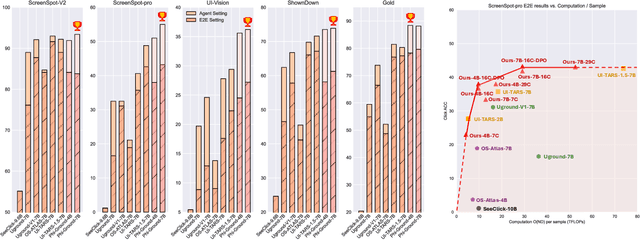
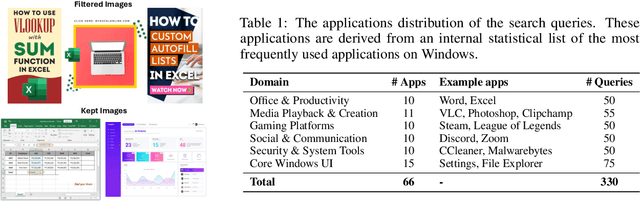
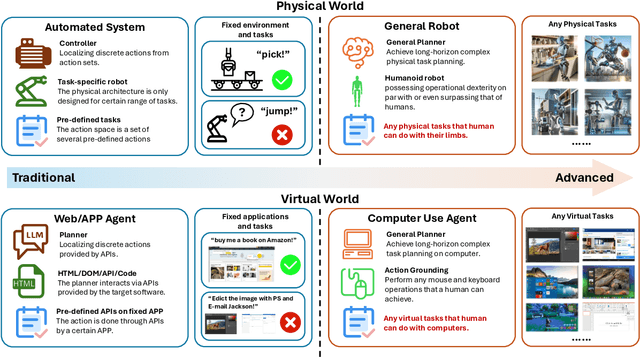

With the development of multimodal reasoning models, Computer Use Agents (CUAs), akin to Jarvis from \textit{"Iron Man"}, are becoming a reality. GUI grounding is a core component for CUAs to execute actual actions, similar to mechanical control in robotics, and it directly leads to the success or failure of the system. It determines actions such as clicking and typing, as well as related parameters like the coordinates for clicks. Current end-to-end grounding models still achieve less than 65\% accuracy on challenging benchmarks like ScreenSpot-pro and UI-Vision, indicating they are far from being ready for deployment. % , as a single misclick can result in unacceptable consequences. In this work, we conduct an empirical study on the training of grounding models, examining details from data collection to model training. Ultimately, we developed the \textbf{Phi-Ground} model family, which achieves state-of-the-art performance across all five grounding benchmarks for models under $10B$ parameters in agent settings. In the end-to-end model setting, our model still achieves SOTA results with scores of \textit{\textbf{43.2}} on ScreenSpot-pro and \textit{\textbf{27.2}} on UI-Vision. We believe that the various details discussed in this paper, along with our successes and failures, not only clarify the construction of grounding models but also benefit other perception tasks. Project homepage: \href{https://zhangmiaosen2000.github.io/Phi-Ground/}{https://zhangmiaosen2000.github.io/Phi-Ground/}
ViaRL: Adaptive Temporal Grounding via Visual Iterated Amplification Reinforcement Learning
May 21, 2025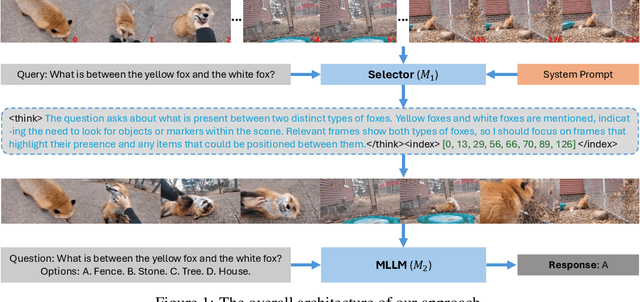
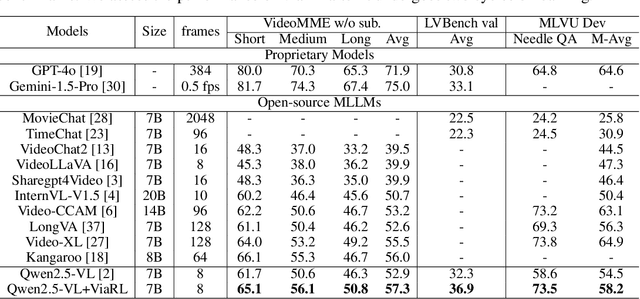
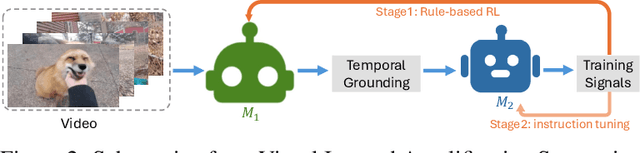
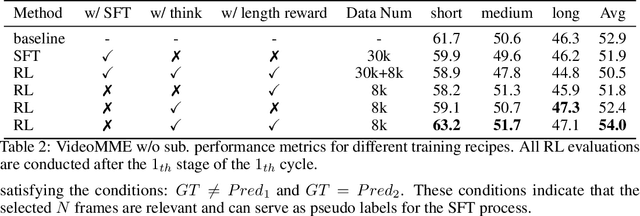
Video understanding is inherently intention-driven-humans naturally focus on relevant frames based on their goals. Recent advancements in multimodal large language models (MLLMs) have enabled flexible query-driven reasoning; however, video-based frameworks like Video Chain-of-Thought lack direct training signals to effectively identify relevant frames. Current approaches often rely on heuristic methods or pseudo-label supervised annotations, which are both costly and limited in scalability across diverse scenarios. To overcome these challenges, we introduce ViaRL, the first framework to leverage rule-based reinforcement learning (RL) for optimizing frame selection in intention-driven video understanding. An iterated amplification strategy is adopted to perform alternating cyclic training in the video CoT system, where each component undergoes iterative cycles of refinement to improve its capabilities. ViaRL utilizes the answer accuracy of a downstream model as a reward signal to train a frame selector through trial-and-error, eliminating the need for expensive annotations while closely aligning with human-like learning processes. Comprehensive experiments across multiple benchmarks, including VideoMME, LVBench, and MLVU, demonstrate that ViaRL consistently delivers superior temporal grounding performance and robust generalization across diverse video understanding tasks, highlighting its effectiveness and scalability. Notably, ViaRL achieves a nearly 15\% improvement on Needle QA, a subset of MLVU, which is required to search a specific needle within a long video and regarded as one of the most suitable benchmarks for evaluating temporal grounding.
HiTVideo: Hierarchical Tokenizers for Enhancing Text-to-Video Generation with Autoregressive Large Language Models
Mar 14, 2025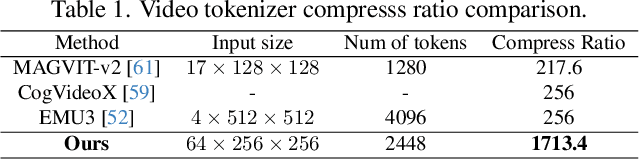
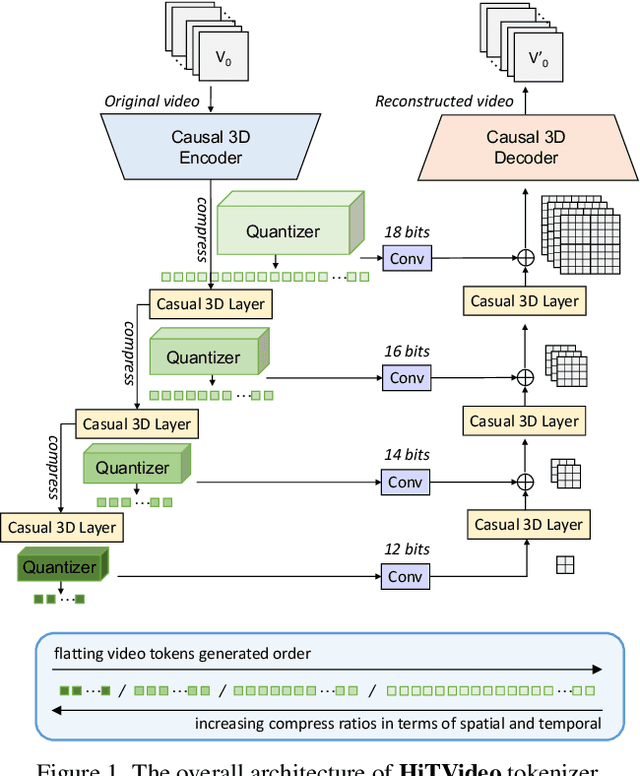
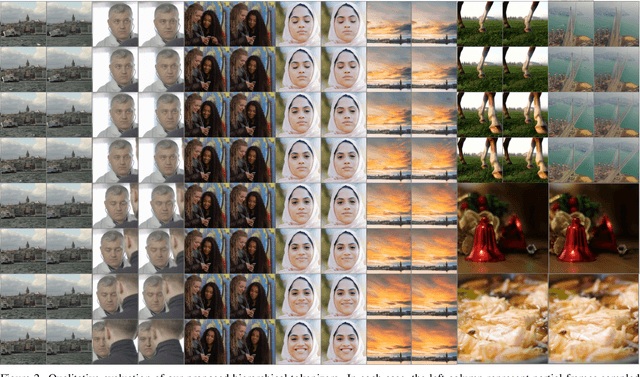

Text-to-video generation poses significant challenges due to the inherent complexity of video data, which spans both temporal and spatial dimensions. It introduces additional redundancy, abrupt variations, and a domain gap between language and vision tokens while generation. Addressing these challenges requires an effective video tokenizer that can efficiently encode video data while preserving essential semantic and spatiotemporal information, serving as a critical bridge between text and vision. Inspired by the observation in VQ-VAE-2 and workflows of traditional animation, we propose HiTVideo for text-to-video generation with hierarchical tokenizers. It utilizes a 3D causal VAE with a multi-layer discrete token framework, encoding video content into hierarchically structured codebooks. Higher layers capture semantic information with higher compression, while lower layers focus on fine-grained spatiotemporal details, striking a balance between compression efficiency and reconstruction quality. Our approach efficiently encodes longer video sequences (e.g., 8 seconds, 64 frames), reducing bits per pixel (bpp) by approximately 70\% compared to baseline tokenizers, while maintaining competitive reconstruction quality. We explore the trade-offs between compression and reconstruction, while emphasizing the advantages of high-compressed semantic tokens in text-to-video tasks. HiTVideo aims to address the potential limitations of existing video tokenizers in text-to-video generation tasks, striving for higher compression ratios and simplify LLMs modeling under language guidance, offering a scalable and promising framework for advancing text to video generation. Demo page: https://ziqinzhou66.github.io/project/HiTVideo.
Robust Latent Matters: Boosting Image Generation with Sampling Error
Mar 11, 2025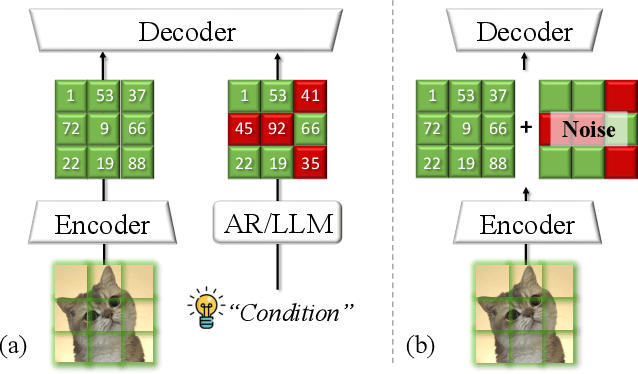
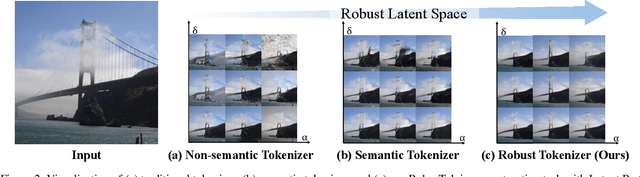
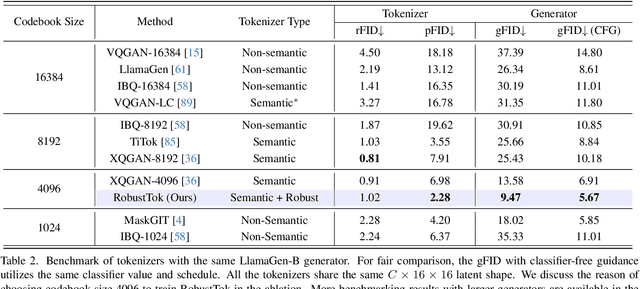
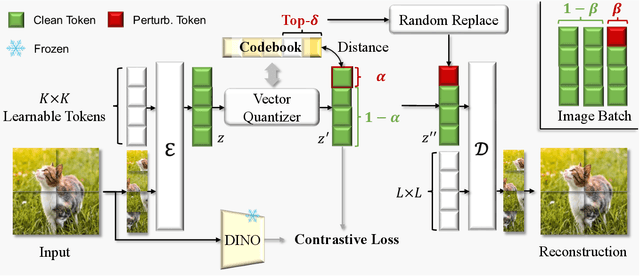
Recent image generation schemes typically capture image distribution in a pre-constructed latent space relying on a frozen image tokenizer. Though the performance of tokenizer plays an essential role to the successful generation, its current evaluation metrics (e.g. rFID) fail to precisely assess the tokenizer and correlate its performance to the generation quality (e.g. gFID). In this paper, we comprehensively analyze the reason for the discrepancy of reconstruction and generation qualities in a discrete latent space, and, from which, we propose a novel plug-and-play tokenizer training scheme to facilitate latent space construction. Specifically, a latent perturbation approach is proposed to simulate sampling noises, i.e., the unexpected tokens sampled, from the generative process. With the latent perturbation, we further propose (1) a novel tokenizer evaluation metric, i.e., pFID, which successfully correlates the tokenizer performance to generation quality and (2) a plug-and-play tokenizer training scheme, which significantly enhances the robustness of tokenizer thus boosting the generation quality and convergence speed. Extensive benchmarking are conducted with 11 advanced discrete image tokenizers with 2 autoregressive generation models to validate our approach. The tokenizer trained with our proposed latent perturbation achieve a notable 1.60 gFID with classifier-free guidance (CFG) and 3.45 gFID without CFG with a $\sim$400M generator. Code: https://github.com/lxa9867/ImageFolder.